Ctrl-Cost: See What You Overpay for SAP — Before the Auditor Does
How on-premises AI turns your SAP license data into a defensible number — in hours, not months.
Every enterprise running SAP is carrying a number it can't see.
It sits quietly inside user licenses, transaction logs, and contract clauses — and most organizations only discover it the hard way, when the audit letter arrives. For many, that number is 30–60% of their SAP license spend: paid year after year for capabilities no one actually uses.
This is one of the most expensive blind spots in enterprise IT, and it has survived for a simple reason. License management has always been a spreadsheet-and-consultant exercise, built on role assumptions rather than real usage. Someone is assigned a "Professional" license because of their job title — not because of what they do in the system. Multiply that across thousands of named users, add indirect (Digital) Access, layer on the S/4HANA FUE conversion that every RISE migration now forces, and you get a picture no one can defend with confidence. So companies overpay to feel safe, and still get surprised at audit time.
Why this is a growth problem, not just an IT one
It's tempting to file SAP licensing under "procurement housekeeping." It isn't.
Every euro locked in over-licensing is margin that never reaches the business. Every under-licensed user is uncapped audit risk sitting on the balance sheet. And every renewal negotiated without your own independent number is a negotiation you've already half-lost. For a CFO or a growth-minded leadership team, license intelligence is quietly one of the highest-ROI things you can fix — because the savings are real, recurring, and require no new revenue to capture.
The problem has always been getting to a trustworthy number fast enough for it to matter.
The obvious answer — and the real obstacle
This is exactly the kind of problem modern AI should solve. Classify millions of transactions, reason over dense contract language, model different licensing scenarios — that's pattern work at a scale humans can't match by hand.
But there's a catch that stops most tools cold: SAP data is among the most sensitive data a company owns. Uploading user activity and contract terms to a cloud SaaS is a non-starter for a lot of security and legal teams — and rightly so.
So the real unlock isn't just "add AI." It's AI that runs entirely on-premises, where the data already lives.
What we built: Ctrl-Cost
That's the problem we set out to solve at GNDLF with Ctrl-Cost — an on-premises SAP License Intelligence platform that shows exactly what you overpay, before your next audit.
Point it at your SAP export, and one run turns raw data into an audit-ready position:
• User-level classification traceable to the transaction — every user sized by what they actually do, not their role (Professional / Limited / Employee / Developer)
• Annual savings from right-sizing over-licensed users
• Early audit-exposure detection for the under-licensed users that create real risk
• S/4HANA FUE projection for RISE renewals and migration planning
• USMM / LAW reconciliation and Digital Access (indirect use) estimation
• Contract analysis and an audit-readiness score, with benchmarks and a task board your team can work through
The difference that makes it deployable: it's 100% on-premises — including the AI. The built-in Copilot explains every recommendation and reads your contract using a model that runs on your own server. Your SAP data never leaves the building. No cloud uploads. And the tool only reads SAP — it never writes to it.
For most SAP teams, that last paragraph is the line between an interesting demo and something security will actually approve.
What it looks like in practice
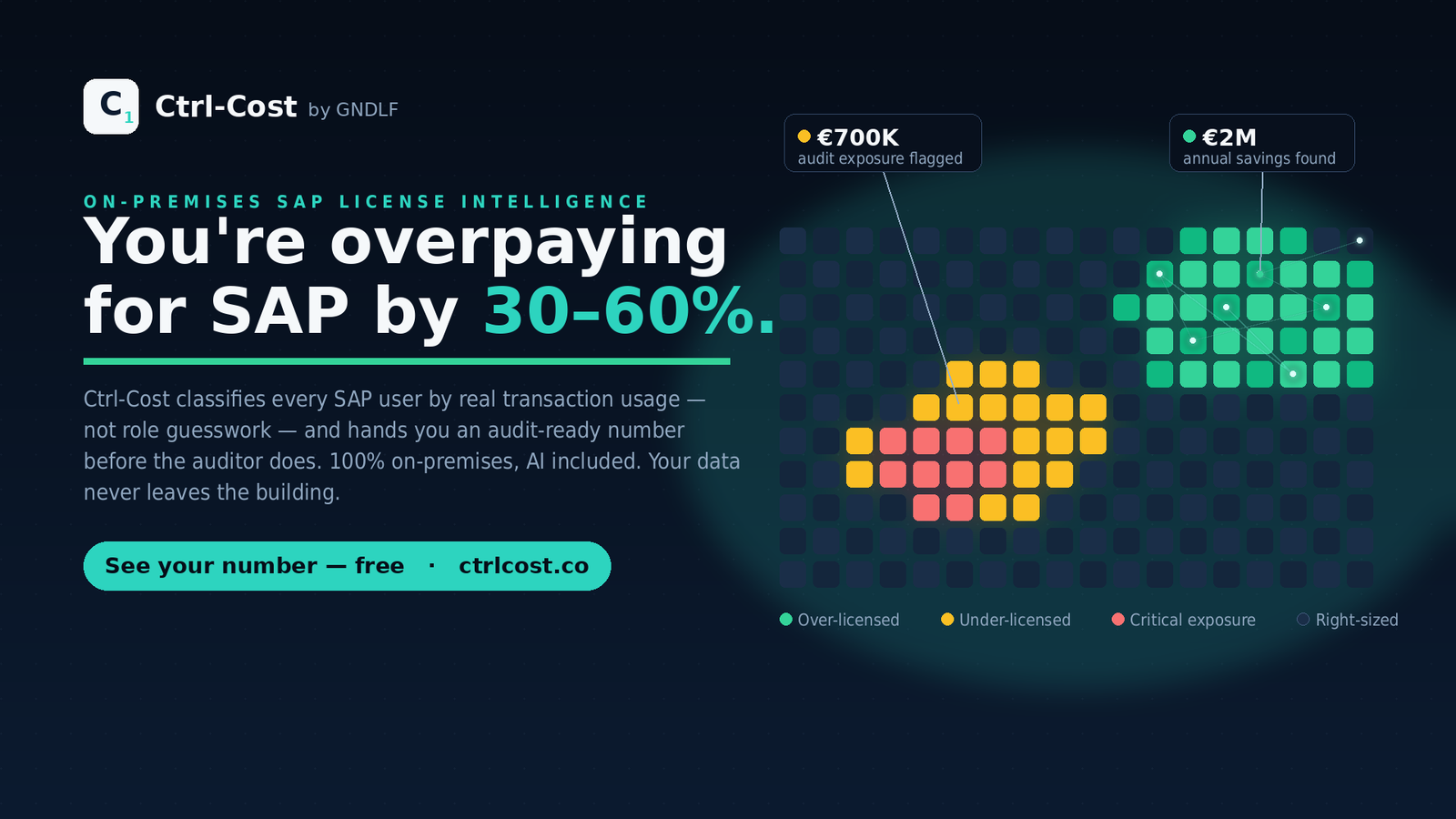
In a 2,000-user example, Ctrl-Cost surfaced €2M in annual savings and flagged €700K of audit exposure — in an afternoon, not months of consulting.
Same data the team already had. A very different answer than the one they were paying for.
The takeaway
The pattern here is bigger than SAP. Across the enterprise, the highest-leverage AI use cases aren't the flashy ones — they're the ones that take data you already own, run where it already lives, and turn it into a decision you can defend. Cost governance is one of the clearest examples, and it's one where on-premises AI has a structural advantage over cloud-only tools.
If you run SAP, the fastest way to understand any of this is to stop reading estimates — including mine — and see your own number.